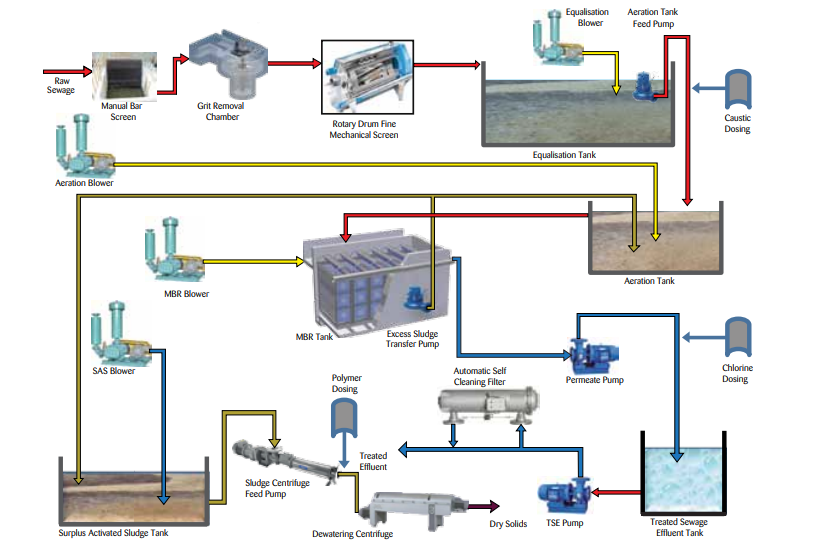
Process Description
Inlet Works
Flow from the pumping stations arrives at a receiving chamber, where it is directed to the inlet works pre-treatment station. The station includes sand, oil and grease removers, a sand classifier, two fine screens (one duty and one stand-by), and one screw compactor for screened material.
Mechanical Screens
Raw sewage from the reception chamber passes through screens to remove all floating material. Screenings are then discharged to a screw conveyor where they are compressed through a compactor and transferred to a receiving skip. The screened material is transported off-site by a registered waste contractor and disposed to landfill.
Grit Removal
Following screening, sewage flows to a vortex type grit chamber where it goes through a rotational flow pattern. The resulting sewage velocity is sufficiently high to prevent the settlement of light organic solids while the heavier sand and grit settle to the bottom of the tank. De-gritted sewage passes through a flow measurement channel to the equalisation tank for further treatment, while collected grit slurry is pumped and delivered to a classifier where water and grit get separated. Water is drained back to the equalisation tank, while solids are transported by conveyor belt to a skip and taken off-site for appropriate disposal.
Equalisation Tank
Flow equalisation overcomes the operational problems caused by varying flow rate patterns, and improves performance of the subsequent processes. Equalisation also buffers BOD fluctuations and eliminates shock loading.
Air under low pressure is supplied through down feed pipes with diffusers to the bottom of the equalisation tank to prevent settling and septic decomposition of organic matter.
Biological Treatment
Aeration Tanks
Sewage is pumped by the feed transfer pumps to the aeration tanks. The aeration tanks provide an aerobic environment to ensure nitrification of ammonia and oxidation of BOD, which is achieved by the provision of high efficiency, fine bubble diffused aeration. The aeration tanks include an anoxic zone for effective de-nitrification.
The air blowers are provided with variable frequency drives linked to a Dissolved Oxygen (DO) meter, to maintain the desired residual DO concentration in the aeration tanks.
Two horizontally mounted rotor aerators are provided in each aeration tank, which help mix the activated sludge and increase the amount of oxygen by creating turbulence in the water.
pH Balancing – Sodium Hydroxide
Alkalinity in wastewater results from the presence of hydroxides (OH⁻), carbonates (CO₃²⁻), and bicarbonates (HCO₃⁻). The concentration of alkalinity in wastewater is important where biological nutrient removal is used. Alkalinity is maintained within the required range by injecting sodium hydroxide in the aeration tanks.
Membrane Bio-Reactor (MBR) Tanks
Submerged membrane technology is an advanced, cost effective technology. The MBR process is a suspended growth activated sludge one that utilises micro porous membranes for solid and liquid separation in lieu of secondary clarifiers (settling tanks).
There is a total of six membrane tanks which combine the function of solid separation and biological degradation. The membrane units remove solids to less than 5 mg/l. They are scoured by coarse bubble aeration to prevent fouling. Provision has been made to chemically clean the membranes, usually twice per year, using dilute Sodium Hypochlorite for bio-fouling. A diffuser flushing system is also used to periodically flush the coarse bubble diffusers.
Surplus sludge is drawn from the membrane tanks at approximately 1.4% to 1.8% dry solids, and is transferred to a tank.
Disinfection
The MBR process removes a large portion of bacteria from sewage. However, the effluent from the system may contain some pathogens due to contamination. For this reason, Sodium Hypochlorite is dosed into a Chlorine Contact Tank to remove or inactivate the remaining pathogenic bacteria.
After disinfection, TSE from Saadiyat STP-1 is transferred to a treated water tank, and is used for irrigation on Saadiyat Island and as top-up water for Saadiyat Beach Golf Course Lake 15.
Sludge Handling
Excess sludge from the MBR tanks is pumped intermittently by the sludge recycle pumps to the SAS tank. The tank is provided with an aeration system to prevent the settling of suspended solids. SAS sludge is then transferred by progressive gravity pumps to sludge centrifuges for dewatering, aided by polymer injection.
Dewatered sludge is conveyed via screw conveyors to sludge skips, where it is taken off site by a registered waste contractor for disposal at landfill.
Odour Control
Structures that may generate odour include:
All of these structures will be vented to the atmosphere via an odour control system.
The odour control unit includes two counter-current scrubbers in series, followed by an activated carbon vessel as a deodorising unit (DU). In addition, a second line of counter-current scrubbers which are connected to the same activated carbon vessel, are connected together with a stand-by fan.
Counter Current Scrubbers
Hydrogen sulphide laden air passes through the inlet ductwork and enters the odour control wet chemical scrubber.
Gases move vertically upwards from the low-level side inlet through the packing contained in the tower. A downwards flow of scrubbing liquor intimately mixes with the up-flowing gas resulting in removal of the sulphur-based compounds. A conductivity meter monitors the conductivity of the re-circulating liquor.
From the first packed section of the scrubber gases pass to the second packed section where the process is repeated, thus providing the final cleaning of foul air. Gases then exit the tower through a mist eliminator. Free drops of water are removed from the gas stream by impact on the chevron collection elements. Collected moisture coalesces into a sheet of liquid that drains freely back into the scrubber vessel.
Activated Carbon Unit
The activated carbon vessel is used to further reduce the low H₂S concentrations after the scrubbers.
The vessel is filled with regenerable activated carbon on which the malodorous organic compounds are adsorbed, and the incoming hydrogen sulphide catalytically oxidised in the fine pore structure of the carbon. The carbon used is vapour phase activated carbon that has been specifically developed for odour removal in sewage treatment operations.
A detection of hydrogen sulphide at the upper air sampling port indicates when the activated carbon has no further adsorption capacity for hydrogen sulphide, at which time it is regenerated.
Design Standards
The odour control installation is designed to the following standards:
-
Flow Rate: 10,000 m³/hour
-
Maximum H₂S inlet concentration under natural ventilation: 500 ppm
-
Mean H₂S inlet concentration under natural ventilation: 200 ppm
-
Air Temperature: Ambient
-
Maximum H₂S outlet concentration: 0.00047 ppm